Challenge two: Wait…Was that allowed?
The pressure was definitely rising — both in the house where we lived and in the filming house. Every day we felt more tired. Friendships were getting deeper, but so were other dynamics. We supported each other a lot, but at the same time we were becoming more sensitive to anything that felt even slightly unfair. At that stage, even a tiny thing could set everyone on edge.
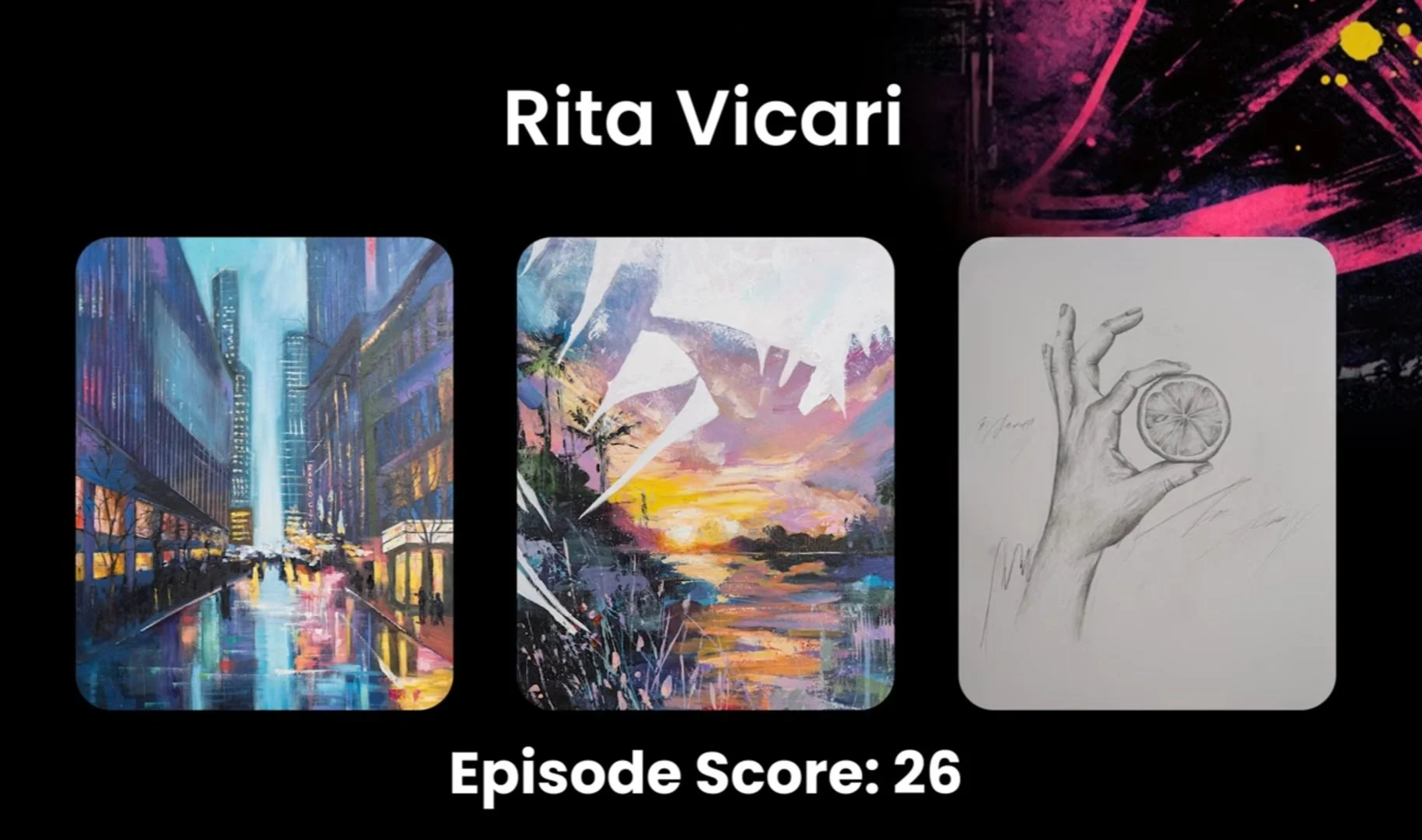
The abstract landscape challenge was disappointing for me. I somehow couldn’t pull the painting together without adding the white background. At home, the white background is something that gives me both comfort and excitement. When I add it, I almost exhale and think, now it feels right.
But during the challenge I couldn’t find that same rhythm. I had actually been excited for the abstract landscape because I enjoy painting them in my studio. Under pressure, though, I think I just panicked a bit. I wanted to prove to myself that I can make a painting without the white, and it just didn’t sit right with me. So I added it and felt like it that was what it needed.
The drawing challenge — the hand holding the lemon — was a completely different experience. I loved that one. I still enjoy charcoal much more than graphite; it just feels more expressive and alive to me. Holding the pose was actually harder than I expected. My hand kept cramping and I had to keep relaxing it and finding the position again and again. But overall I genuinely enjoyed the process.
The cityscape challenge was exciting for me as well. I’ve always loved night cities. Interestingly, the reference I chose was a New York street — and only a few months after the show I ended up moving to New York from Texas with my family which was a pretty unexpected move for us.
This actually isn’t the first time something like that has happened. Before we moved to Texas years ago, I painted a collage piece of a coffee cup, and one of the collage elements was a newspaper headline from Texas. About a month later my husband was offered a job there and we moved.
Technically speaking, I struggled again with perspective in the cityscape. But I loved painting the glowing lights and the crowd of people. Night cities have fascinated me since childhood, and I’ve always been drawn to that atmosphere. I lived in a pretty small town in Russia (by Russian standards). We didn’t have high-rises, but I always felt in my heart that big night cities were calling me and had so much energy, mystery and dreamyness to them!
About halfway through the challenge, something else started unfolding.
Some of us noticed that Stephanie seemed to be using a slightly different approach to the subtractive technique. Instead of doing the way it is shown in the program, she used a variation that saved quite a bit of time.
Naturally, questions started appearing.
In the Mastery Program the method is usually demonstrated in a very specific way, so we began wondering: were variations allowed? Were we misunderstanding the instructions? Or were we all supposed to follow the exact same process?
Looking back, I think this was really a moment where assumptions started forming.
Stephanie believed she was working within the rules. And we believed we were following the rules the way they had been taught to us. In many ways, both things were true.
But competitions have their own psychology. When eleven people interpret something one way and one person approaches it differently, the imbalance naturally raises questions. It wasn’t about attacking someone — it was about trying to protect fairness in a situation where everyone had sacrificed a lot to be there.
Stephanie is an incredible artist and a wonderful human being. Later, when I learned more about her story, I understood why the situation was especially painful for her when questions were raised and accusations were made. That realization made me feel for her even more.
But at that moment, all of us had left our families, our work, and our normal lives behind to be there. The feeling in the house was that fairness mattered, and we wanted to address what we were seeing.
What fascinated me most was how quickly assumptions can grow under pressure — and how easily a group can start creating stories to make sense of what they see.
And that story… continued into the next episode.